
Delft 1584 – Delft 1641
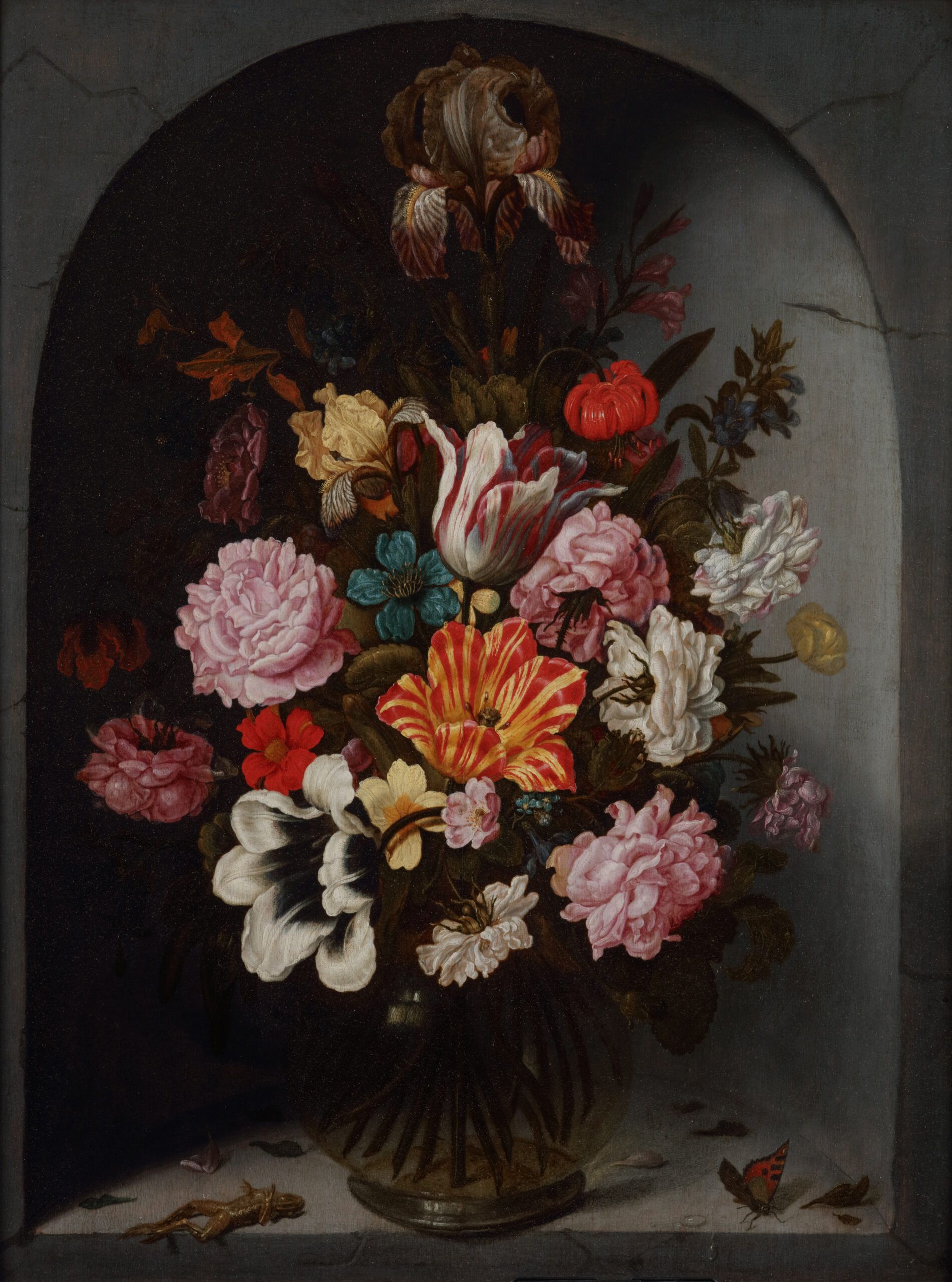
A Still Life of Flowers in glass Vase standing in a stone Niche
Oil on panel
H. 78 cm. W. 58 cm.
PROVENANCE
With Edward Speelman | London | 1950 | As by Ambrosius Bosschaert
Private collection | United Kingdom | Acquired from Speelman in August 1950 | Thence by decent
EXPERTISE
With art historic report by Dr. Fred G. Meijer | Nr. 063 | dd. 22 September 2024
CATALOGUE NOTE
This impressive still life depicts a bouquet of flowers in a glass vase, standing in a niche of grey stone. The bouquet includes various types of roses and tulips, irises, martagon lily, forget-me-not, campanula, and gladiolus. Around the vase, at the bottom of the niche, are loose leaves and petals, a dead frog, and a small tortoise shell butterfly.
In his report, dd. 22 September 2024, Dr. Fred G. Meijer attributes this work to the rare Delft master Jacob Woutersz. Vosmaer. Born in the city of Delft, it is unknown from whom Vosmaer learned his trade. He journeyed to Italy, probably after the conclusion of his training. He was back in Delft before early 1608, joining the local Guild before 1613 and working there until his death in June 1641. He was a respected citizen, a captain of the local militia and engaged as such in campaigns in Brabant. Arnold Houbraken (in his De groote schouburgh der Nederlantsche konstschilders en schilderessen (…), 1718) reports that Vosmaer started off as a landscape painter and a seascape by him features in a 1626 Delft inventory. A view of Mookerheide was recorded in his estate after his death. No other works than still lifes, predominantly of flowers, are known today, however. The fact that he occasional painted fruit pieces is borne out by examples mentioned in his estate. His known oeuvre is only small and signed examples are few. Best known is a flower painting, signed and dated ‘1613’, acquired by the Rijksmuseum in Amsterdam in 2019. A second version of the same composition, cut down at the top and (less so) on the sides is in New York. These are early works by the artist, which are quite painterly and mannerist in handling. Vosmaer’s further development can be followed via two dated examples from 1616, and an indistinctly dated example of which the last digit is illegible, but the third is most probably a ‘3’, placing it in the 1630s. Vosmaer’s handling of the flowers, already in 1616, became less mannerist and smoother, and his compositions somewhat more atmospheric. Intriguing is a flower painting that bears an old inscription and date ‘CLAES.IVNBOL. ANNOO.16.2´. On the basis if that inscription, it has been attributed to Anthony Claesz. II (1607-1649), but it fits much better in the oeuvre of Jacob Woutersz. Vosmaer. It shares some flowers with the second example from 1616, while the handling of the roses is closely related to roses in the 1630s example. The date, if at all authentic, is more likely 1632 than 1622. The use of the niche is also a characteristic feature of Vosmaer, although he tended to include only the right edge of the niche in his compositions. The globular glass vase features in all of his known flower paintings after 1613. There can be little doubt that the painting discussed here are by the same hand. The compositions of the two works are very similar, they are virtually the same size and share several flowers. As is clear that Vosmaer tended to repeat motifs and/or flowers (although often not fully identically) and vary closely on compositions. The overblown tulip at lower left in the present bouquet appereas in at least two other bouquets. Due to the facts the present painting is not (or no longer) signed, Dr. Fred G. Merijer states that he attribution will have to remain somewhat tentative, even though motifs and quality point to Jacob Woutersz. Vosmaer.
A date in the 1630s for the present painting appears to be confirmed by the presence of the dead frog at lower left. It appears to have been inspired by a little painting by Ambrosius Bosschaert the Younger, now in Paris. That painting is not dated, but is generally considered to have originated in the second half of the 1630s, which would place the present painting’s origin somewhat after 1635. Assuming that the attribution to Vosmaer is correct, which is highly likely, this makes both paintings late works by the artist. The dead frog enhances the sense of vanitas that is generally borne out by flower paintings, especially when they include several flowers that are past their prime, like here.