
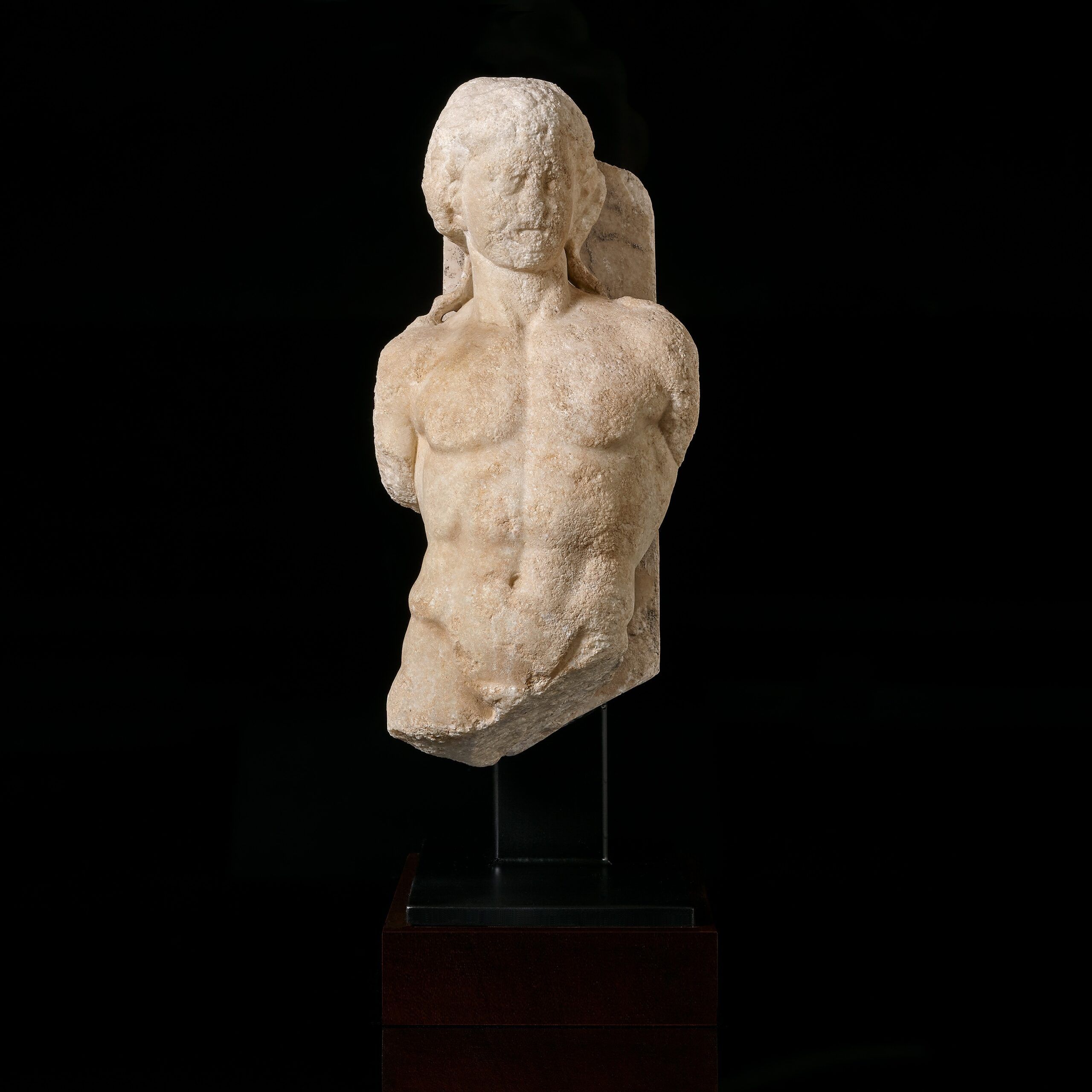
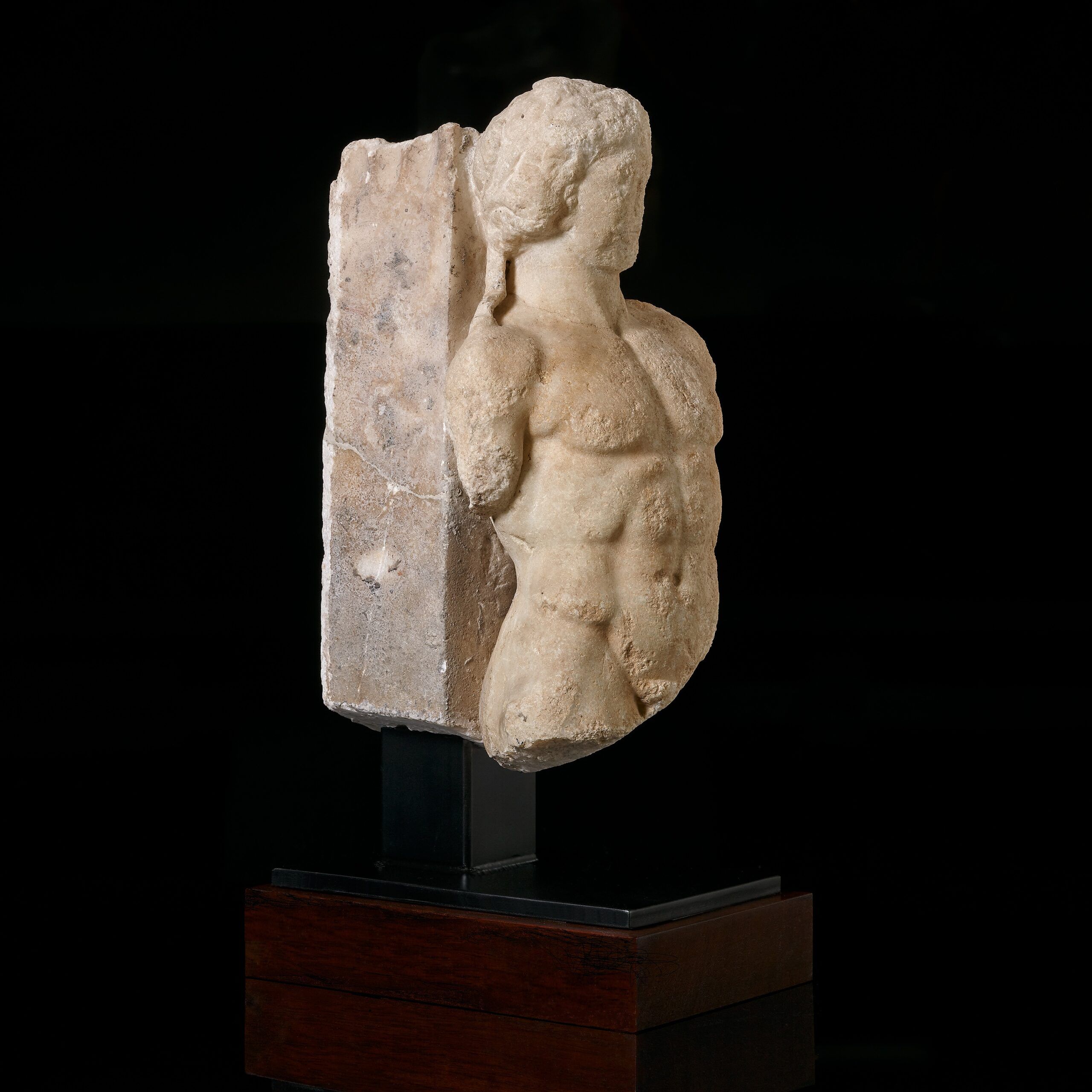
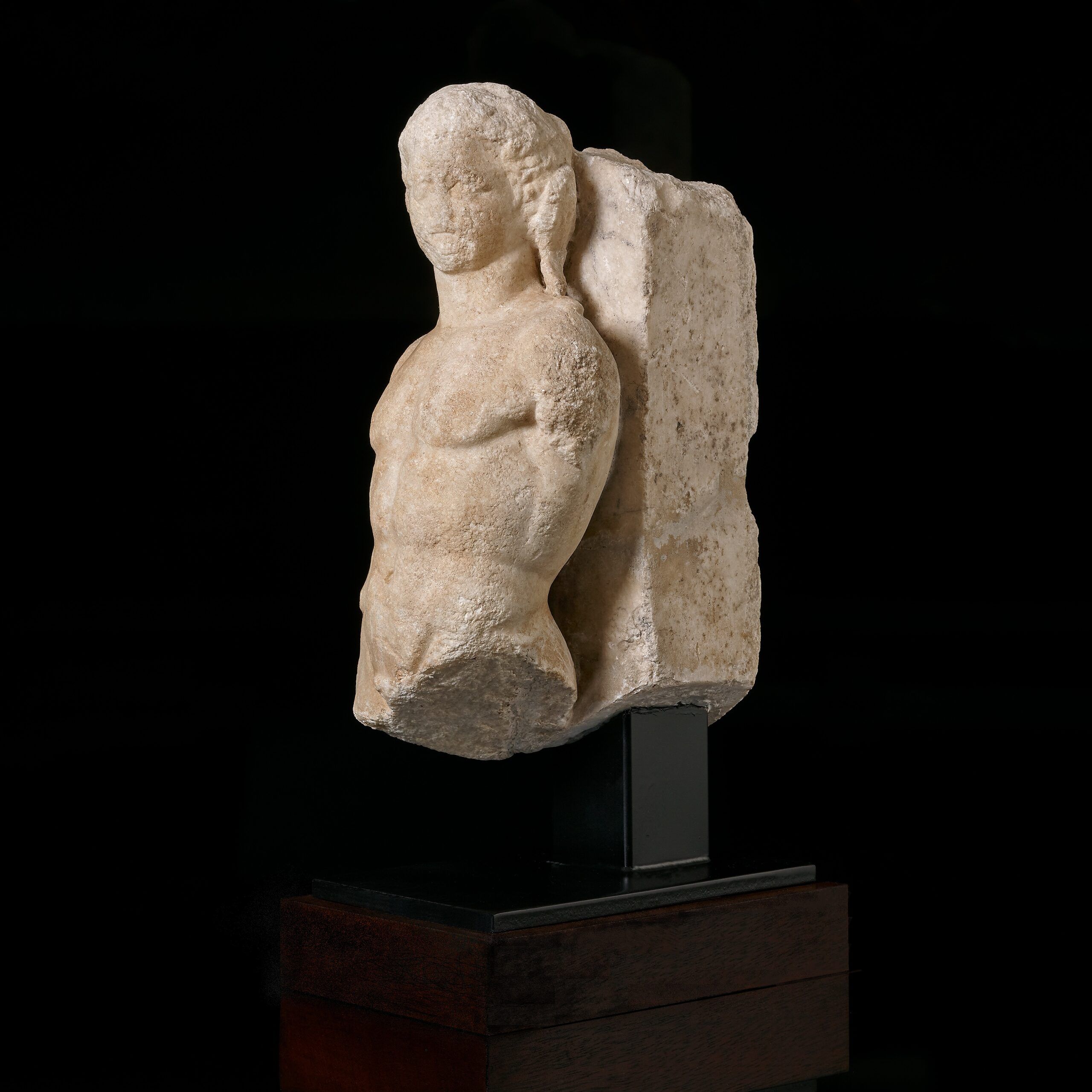
Roman | 2nd Century A.D.
Marble | Carved in full-round | Fragment
H. 34 cm. (excl. later brass base)
PROVENANCE
With Kunstzalen A. Vecht | Amsterdam | 1997 | As possibly Bacchus | Where acquired with proof of purchase, dd. 20 March 1997, by
Dutch private collection | The Hague
REFERENCE LITERATURE
Gercke, P. & Zimmermann-Elseify, N. (2007). Antike Skulpturen und Neuzeitliche Nachbildungen in Kassel. Mainz, pp. 44-50, figs. 45-48, cat.nr. 4.
Pasquier, A. & Martinez, J.L. (2007). 100 chefs-d’oeuvre de la sculpture grecque au Louvre. Paris: Louvre éditions, pp. 52-53
Martinez, J.L. (2004). Les antiques du Louvre. Paris: Fayard, p. 28, p. 40, fig. 20
CATALOGUE NOTE
A ‘trapezophore’, meaning ‘table-bearer’, used as a leg or pedestal, is decorated with the torso of a youth. His body elegantly bowed, with his head slightly turned to the right. His long hair with a central parting and headband, falls in curls on his shoulders. Though previously identified as possibly representing the Wine God Bacchus Dionysus, the sculpture follows the representation known as the ‘Apollo of the Kassel-type’. These sculptures are Roman copies after the famous statue created by Phidias dating from the mid-5th century B.C., made for the Acropolis in Athens. The best example of a Roman copy of Phidias’s statue is kept in the collection of Museum Schloss Wilhelmshöhe in Kassel, Germany (inv.nr.Sk 3), of which the very name of this type is derived. The sculpture has been recognised as the one dedicated by the Athenians to Parnopios Apollo in memory of his saving them from a plague of locusts. Other examples of such sculptues can be found in renowned collection, e.g. Apollon du type de Cassel, dating to the second quarter of the 2nd Century, in the collection of Musée du Louvre, Paris (inv.nr, MR 117.N 839.Ma 884).
In ancient Greek religion and mythology, Apollo is one of the Olympian deities. His numerous functions include healing, prophecy, music, poetry, and archery. He is the son of Zeus and Leto, and the twin brother of Artemis, goddess of the hunt. He is considered to be the most beautiful god and is represented as the ideal of the kouros (‘ephebe‘, or a beardless, athletic youth). In the 5th century BC, his worship was imported to Rome.