
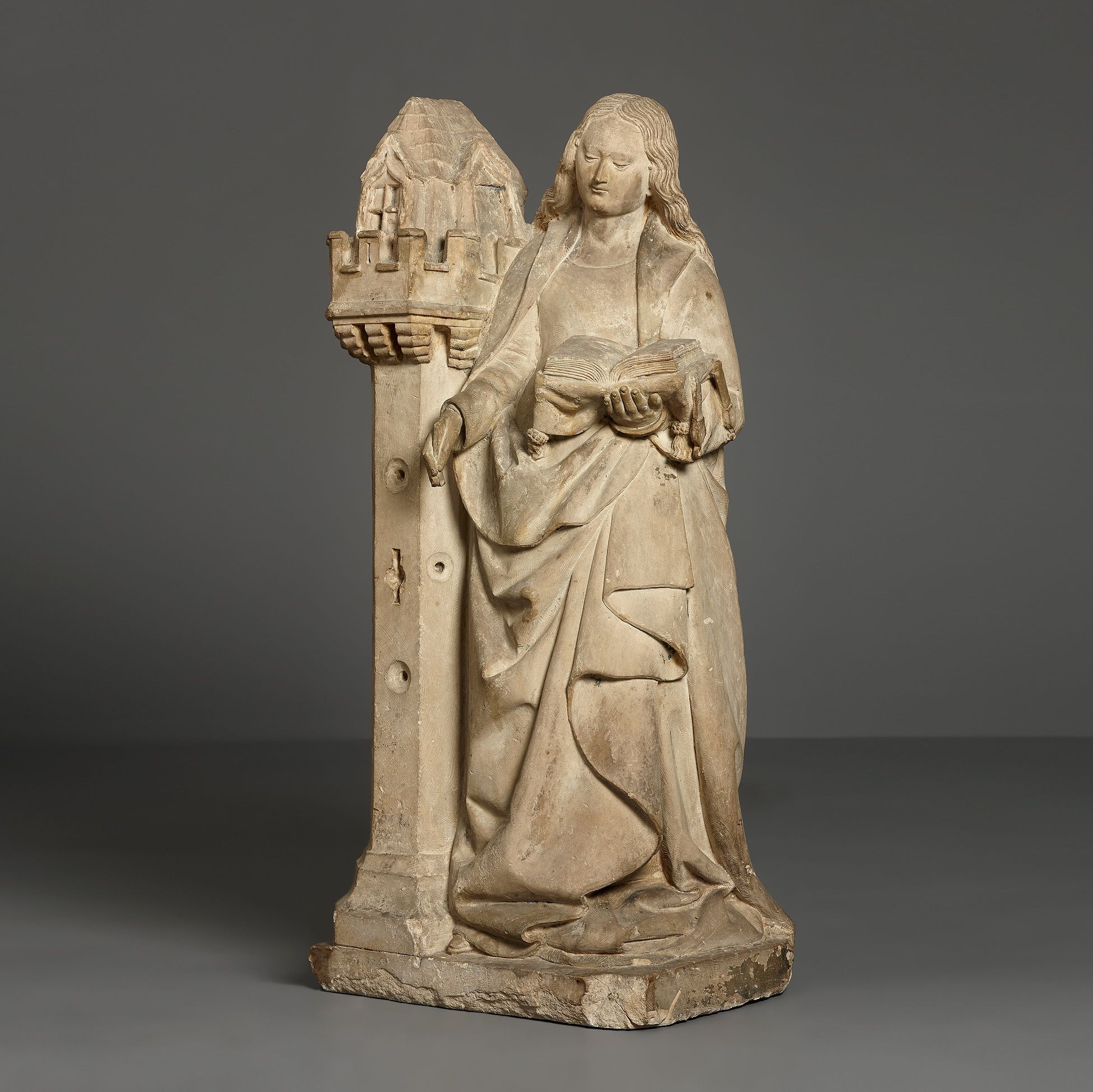
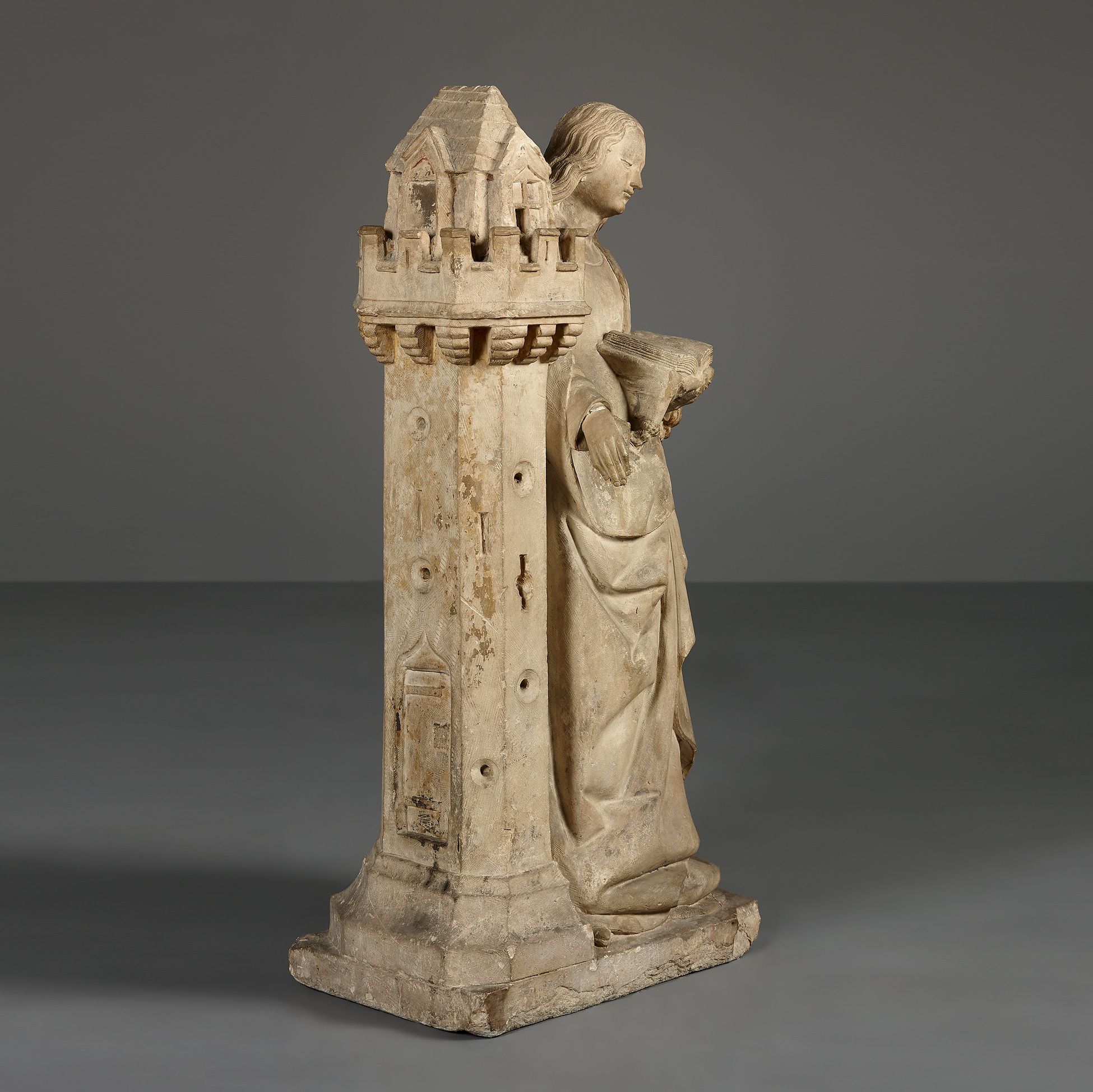
France | Possibly Lorraine
Late Gothic | Last quarter of the 15th Century | Ca. 1490-1500
Limestone | Carved in high relief and full-round | With traces of polychrome
H. 98 cm. W. 50 cm. W. 30 cm.
PROVENANCE
Private collection
REFERENCE LITERATURE
M. Cassidy-Welch, M. (2009). ‘Prison and sacrament in the cult of saints. Images of St Barbara in late medieval art.’ In: Journal of Medieval History, Vol. 35, pp. 371-384
CATALOGUE NOTE
This limestone statue depicts Saint Barbara standing next to her emblematical attribute the three-windowed tower, her gaze piously downcast to the Bible in meditation. Her long, flowing locks drape elegantly over her dress. In her left hand she carries an open Bible, while her right hand grasps the stump of a new lost palm branch, the symbol of her martyrdom. Originally, this fine statue was entirely adorned with polychrome of which traces still remain, e.g. in the structures on top the tower, where patches of red and black or dark blue are still visible in the door openings. A few flecks or red and black or dark blue can be distinguished in the folds of her mantle as well. This impressive sculpture displays the influence of the French sculptor Jean Crocq (active between 1480 and 1510), sculptor, engraver, and ‘master of portraits’ for Duke René II of Lorraine, indicating an origin in Lorraine region. This artist notably created the tomb of Charles ‘the Bold’, the last Duke of Burgundy from the House of Valois-Burgundy, commissioned by the Duke of Lorraine for the Saint George Collegiate Church. Notable are the meticulous treatment of the hair, delicacy of the face, heavy drapery in the garments and the richness of the adorned of the Bible with pearls and tassels.
Saint Barbara lived in Nicomedia, Bithynia, in the late third to early fourth centuries. She was the beautiful and intelligent daughter of Dioscorus, a rich pagan, who imprisoned her in a tower to protect her from the outside world and preserve her virginity. He forbade any contact with friends, only permitting her to see teachers and servants with the orders to educate her in the worship of pagan deities. Barbara spent years in the tower, hoisting food and laundry up and down using a basket on a rope. One day, a stranger handed her a book about Christianity. Upon reading it, she pretended to be ill in order to be attended by a doctor, who was in fact a priest who baptised her in secret. Before leaving on a journey, Dioscorus ordered the construction of a bathhouse for Barbara, which was to have no more than two windows. However, during his absence, Barbara ordered the builders to install three windows, symbolising the Holy Trinity. When Dioscorus returned, he was incensed to find an additional window that he had not given permission for. And when Barbara admitted that she had converted to Christianity and refused a marriage proposal he had organised, Dioscorus truly flew into a rage. He brought her to the provincial prefect, who ordered that she be paraded naked through the city. However, a sudden mist veiled her from the public’s sight. The prefect next ordered that she be tortured and decapitated, yet Barbara refused to renounce her faith under torture, and her wounds were healed every morning. Her execution was ultimately carried out by her father. As he returned home, he was caught in a violent storm, in which he was mortally struck by lightning and consumed by flames that God called down upon him. It is because of this legend that Saint Barbara is invoked for protection against explosions and sudden death. She is venerated by Catholics whose professions carry a risk of unexpected, violent death, and serves as the patron saint of artillery operators, miners, firemen, sailors and prisoners. In Christian art, Barbara is always associated with the tower in which her father imprisoned her. Occasionally it appears as a building in the background, but it is also not uncommon for her to hold a miniature version in her left hand. Placing the saint next to the tower freed up her hands for other attributes, however. Commonly, one of these takes the form of an open copy of the Gospels. In her right hand – as in the present sculpture – she often holds a palm branch, symbolising her virginity, or a sword to symbolise her martyrdom. Barbara is unique among all female saints in Christian art in that she is often portrayed with a chalice representing the Sacred Eucharist. This tradition emerged during the late Middle Ages, when veneration of Saint Barbara shifted its focus from her martyrdom relating to her imprisonment to the miracles she was invoked for. Barbara’s posthumous miracles revolved around dying individuals who feared being unable to receive their last rites. By calling on Saint Barbara, they were able to receive their last rites and pass away in peace. As such, the tower – which formed part of her ante-mortem legend and was associated with her martyrdom – became less important, and artists gave it a different function, e.g. as a holder for the chalice and the host, or they left it out altogether. This changing visual idiom evolved most pronouncedly in Germany and the Netherlands during the late Middle Ages.
The statue of Barbara shown here shows how she was depicted with her tower before this transition. This is not so odd, considering how churches and cathedrals – which this statue was likely produced for – took decades or even centuries to build, meaning that a more classic visual idiom might have been a better fit for the original commission. It is also possible that the idiom shift and the change in Saint Barbara’s veneration varied strongly by location – in other words, that iconography did not necessarily change as a whole throughout Western Europe.