
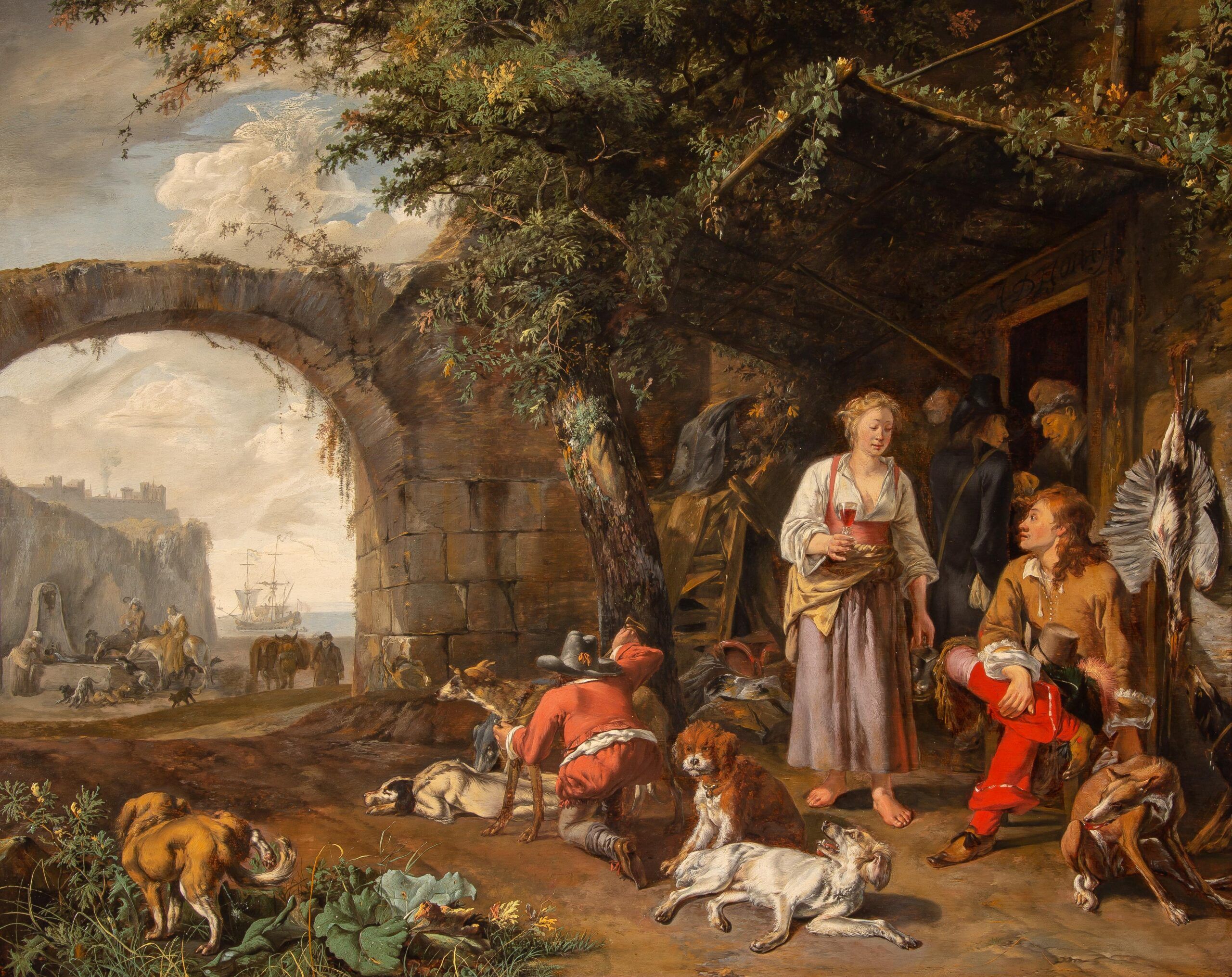
Rotterdam 1625/30 – London 1691
Refreshment outside an Inn after a Hunt
Signed and dated ‘ADHont. F/1651’ | Upper right
Oil on panel
H. 87,7 cm. W. 108,9 cm.
PROVENANCE
Collection H.L. Bisschoffsheim | Bute House | London
His sale | Christie’s | London | 7 May 1926 | Lot 110 | As Hondius and Weenix
Sold with pendant to Parsons
Anonymous sale | Christie’s | London | 11 April 1986 | Lot 26
With Richard Green | 1994
Anonymous sale | Sotheby’s | New York | 16-5-1996 | Lot 86 | Where bought by the previous owner
LITERATURE
Harwood, L.B. (1994). A Golden Harvest. Paintings by Adam Pynacker. Williamstown Massachussets: Sterling and Francis Clark Institute, exhibition catalogue, pp. 25-26, ill. 20
Peyser-Verhaar, M. (1998). ‘Abraham Hondius, his life and background.’ In: Oud Holland, Vol. CXII, pp. 151-152, ill. 1
REFERENCE LITERATURE
Rapp, B. (1949). ‘Abraham Hondius.’ In: Oud Holland, Vol. LXIV, no. 2, pp. 65-66, reproduced p. 67, ill. 2.
CATALOGUE NOTE
The Dutch Golden Age painter Abraham Danielsz. Hondius, known for his depictions of animals, was born in Rotterdam. He was the son of a city stonemason, Daniel Abramsz de Hondt. Hondius trained under Pieter de Bloot (1601–1658) and Cornelis Saftleven. He lived in Rotterdam until he moved to Amsterdam in 1659. He migrated to London in 1666, where he spent the rest of his life. Throughout his career, Hondius combined several stylistic influences and struggled to develop a style of his own. However, he specialized in animal pieces: more than two-thirds of his paintings, etchings and drawings are hunting scenes, animals fighting and animal studies, following a tradition established by Antwerp artist such as Frans Snyders, Paul de Vos and Jan Fyt whose work has been well known in the Netherlands. He also painted landscapes, genre and religious scenes. He also painted views of London such as The Frozen Thames and London Bridge. His last known work is Ape and Cat Fighting over Dead Poultry, dated 1690.
This picture, date ‘1651’ is one of the earliest recorded works by Abraham Hondius. Painted when the artist was no more than 20 years old, demonstrates his already prodigious talent when working in Rotterdam before his moving to Amsterdam in 1659. During his formative years, Hondius frequently returned to depictions of the restful moments before or after the hunt, rendering the surrounding foliage and vegetation with great accuracy and detailed observation. Another painting by Hondius of the same date, and signed in a similar way was in the A. Friedman collection Stockholm (see: Rapp, 1949, pp. 65-67, ill. 2).