
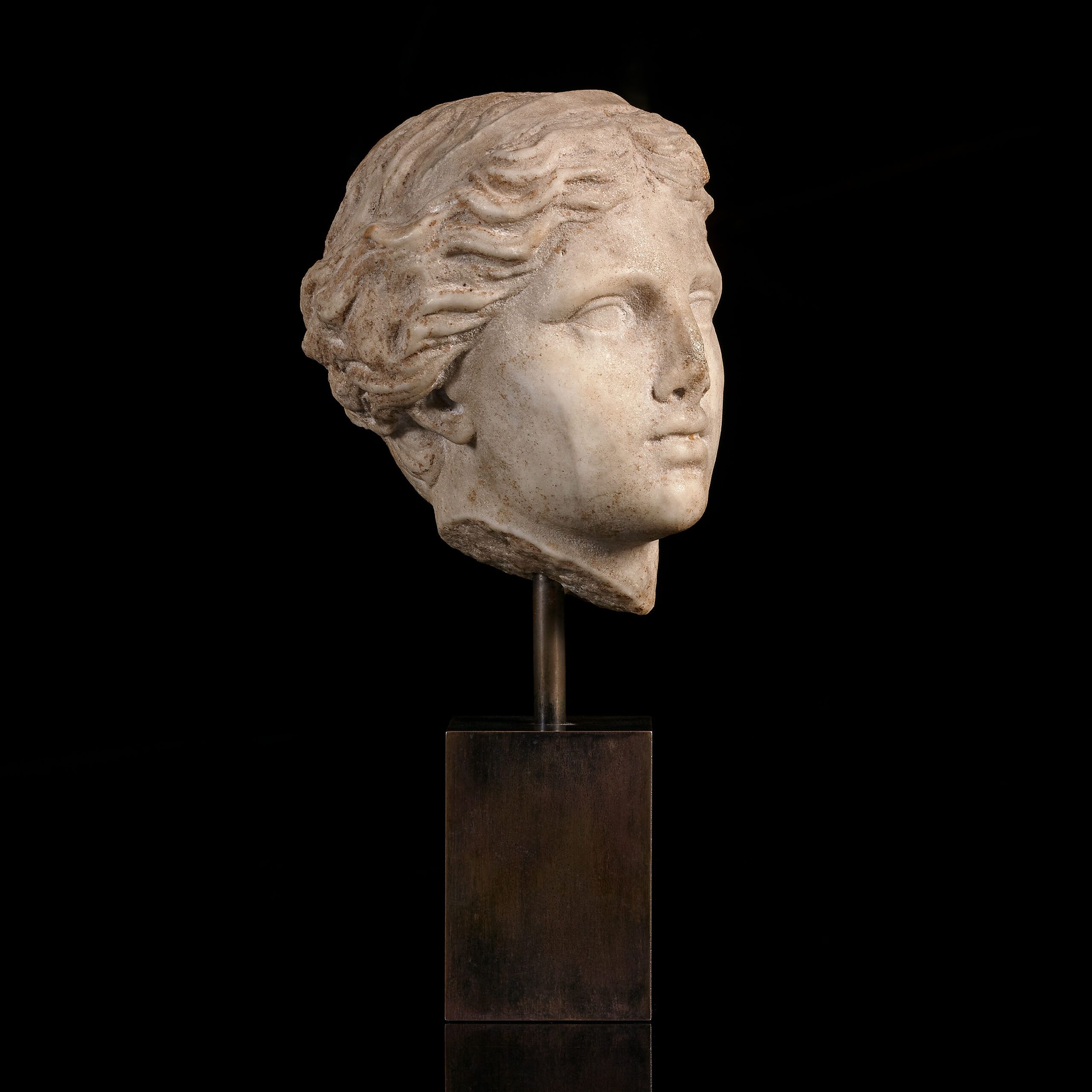
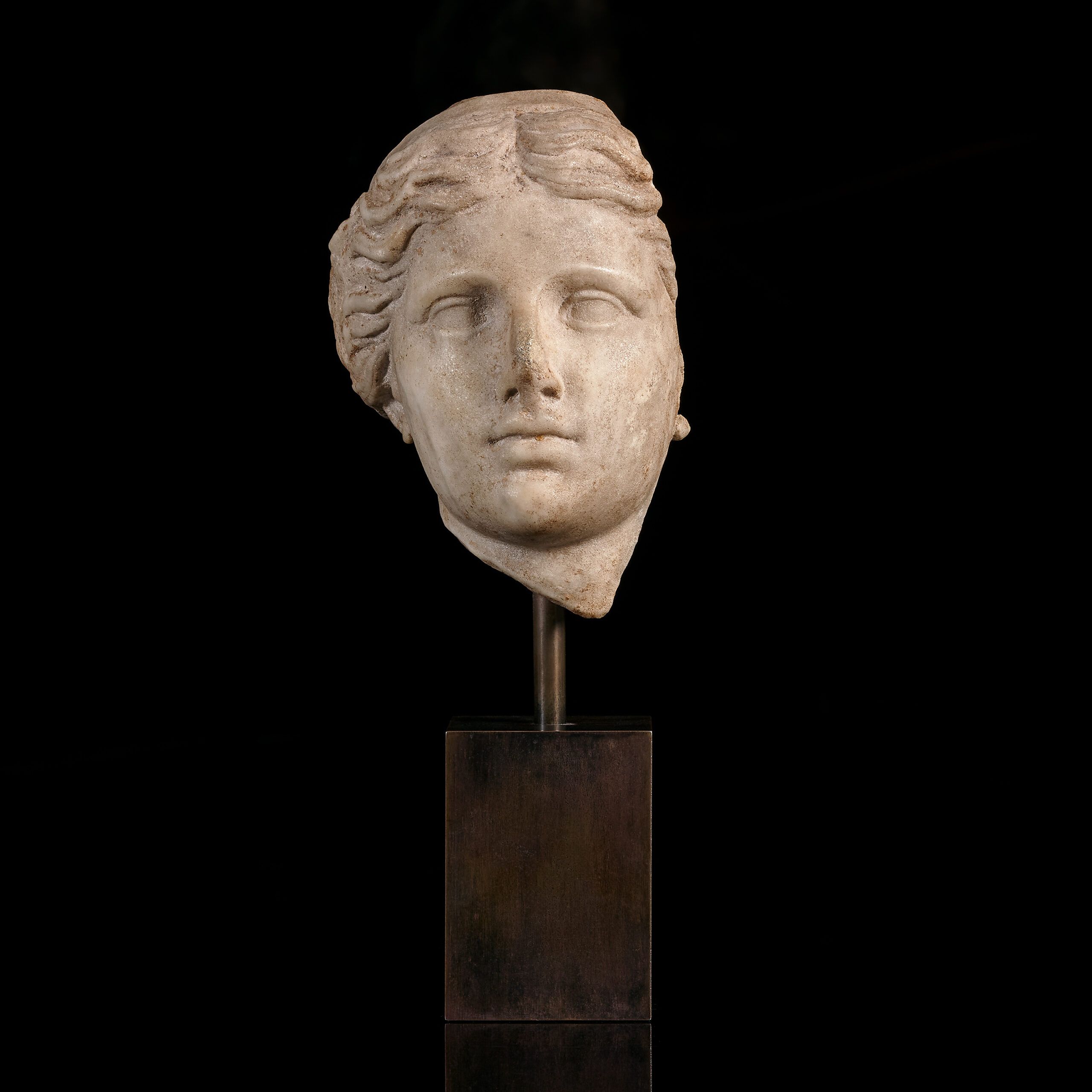
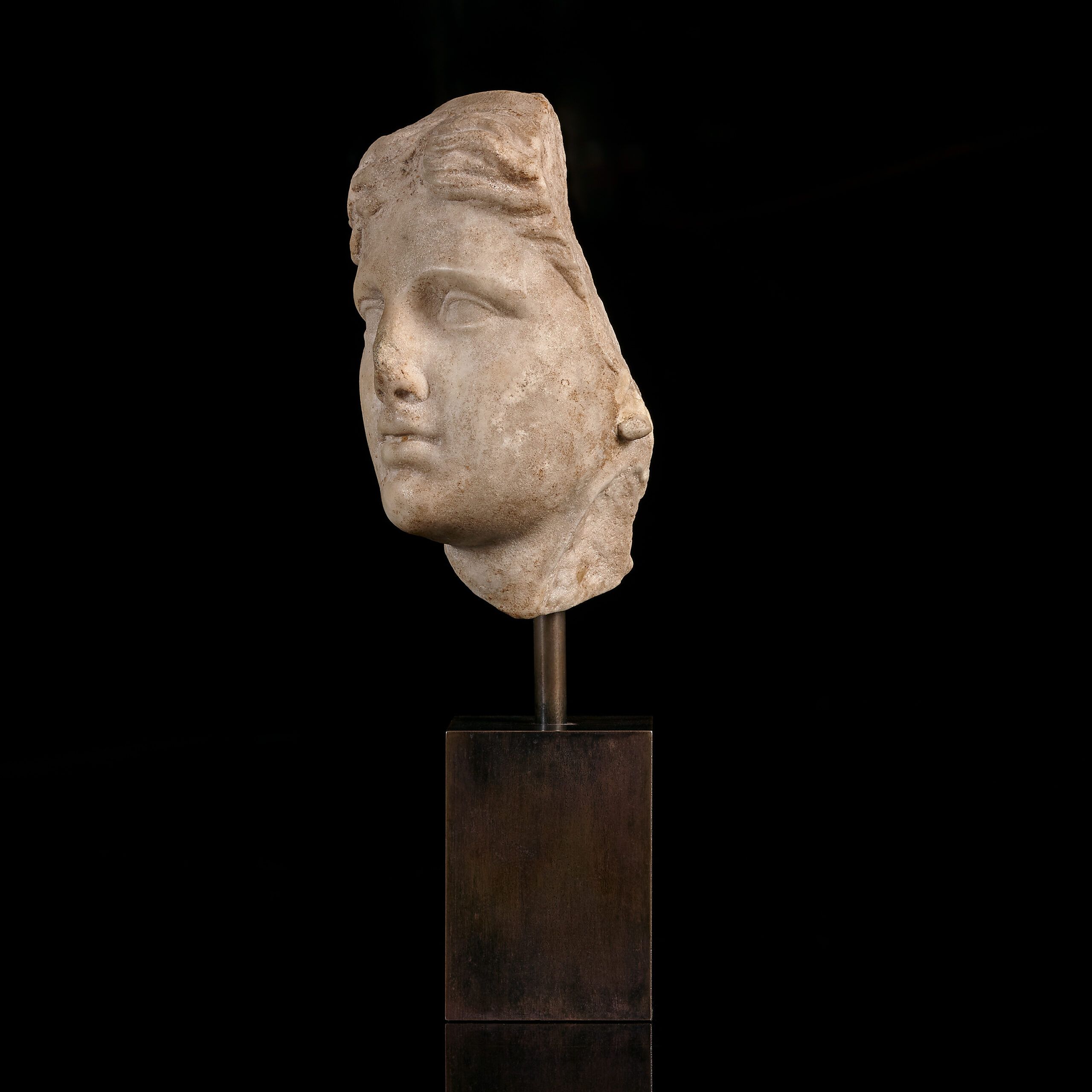
Hellenistic period | 3rd Century B.C.
Pentelic marble | Carved in full-round | Fragment
H. 12,7 cm. (excl. later brass base)
PROVENANCE
With Kunsthandel Mieke Zilverberg | Amsterdam | 1998
Dutch private collection | The Hague
EXHIBITION
TEFAF | Maastricht | 1998| Acquired from the above| With proof of purchase, dd. 10 March 1998
REFERENCE LITERATURE
Griffiths Pedley, J. (1993). Greek Art and Archaeology. New York, pp. 299, ill. 9.30; p. 434, ill. 10.36
Mitchell Havelock, Ch. (2010). The Aphrodite of Knidos and her successors. Ahistorical review of the female nude in Greek art. Ann Arbor: University of Michigan Press. p. 26
Pasquier, A. & Martinez, J.L. (2007). 100 chefs-d’oeuvre de la sculpture grecque au Louvre. Paris: Louvre éditions, pp. 156-157
Schröder, S.F. (2004). Catálogo de la escultura clásica: Museo del Prado II. Madrid: Museo Nacional del Prado, pp. 114-118
CATALOGUE NOTE
Aphrodite, the ancient Greek goddess of love and beauty, identified with Venus by the Romans. Aphrodite was widely worshipped as a goddess of the sea and of seafaring. She was also honoured as a goddess of war, especially at Sparta, Thebes, Cyprus and other places. However, she was known primarily as a goddess of love and fertility and even occasionally presided over marriage. This fine example of Greek sculpture from the third century B.C. follows the example of the renowned Aphrodite of Knidos by Praxiteles from the middle of the 4th century B.c. The original has been lost, but the Knidian Aphrodite was one of the most widely copied statues in the ancient world. Probably the most faithful replica of the statue as a whole is the Colonna Venus conserved in the Museo Pio-Clementino, part of the collections of the Vatican Museums (inv.nr. 812). The so-called Kaufmann Head, found at Tralles and purchased from the Von Kaufmann collection in Berlin and at present kept in the collection in the Musée du Louvre (inv.nr. MND 2027), is thought to be a very faithful Roman reproduction of the head of the Knidian Aphrodite. Another example, the can be found in the collection of the collection of Museo del Prado in Madrid (inv.nr. E000054). The present piece is remarkable, sice it is not a Roman copy, but a Greek example dating to the 3rd century B.C.
This exquisite head is carved out of pentelic marble, a type of white marble quarried at Mount Pentelicus in Attica, Greece, situated north-east of Athens and south-west of Marathon. This marble has been famous since antiquity and was used for the construction of public buildings in ancient Athens in the 5th and 4th centuries B.C., particularly the Acropolis and the Parthenon. Praxiteles and other Greek sculptors executed their principal works in Pentelic marble. In classical times, the peak had 25 quarries on the south slope. The white marble is calcitic in composition with quartz as an accessory mineral.