
The Hague | Michiel Menningh
Louis XIV | 1720
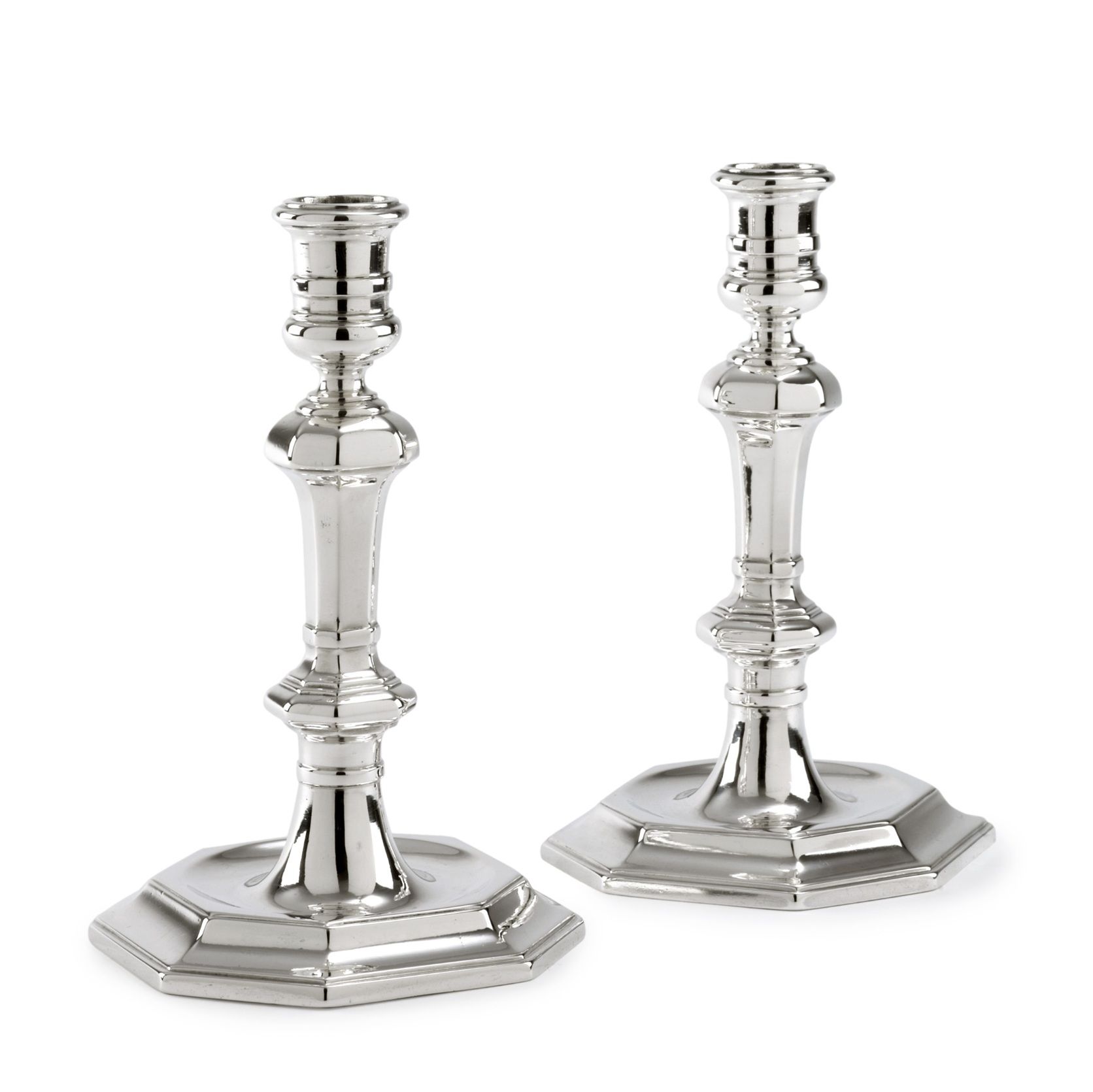
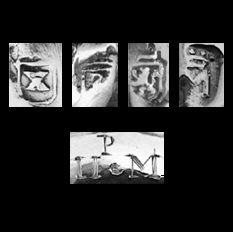
Silver | Fully marked | Engraved on the reverse of the foot with the initials ‘P/ H & M.’
H. 18.5 cm. 813 grams
PROVENANCE
Private collection | The Netherlands
REFERENCE LITERATURE
Voet, E. (1941). Merken van Haagsche Goud- en Zilversmeden. Den Haag
Pijzel-Dommisse, J. (2005). Haags goud en zilver. Zwolle
CATALOGUE NOTE
This fine pair of Louis XIV candlesticks are raised on stepped square bases with cut corners. The baluster stems rise from a shallow roundel and are facetted above the facetted knob. The spool sconces are applied with a small plain central band. Both candlesticks are fully marked, the one on the exterior of the foot rim, the other at the corners of the interior of the foot. Both candlesticks display assay stripes at the reverse of the foot.
The silversmith Michiel Menningh was born on 24 August 1687, as son of the Hague gold and silversmith Cornelis Menningh (1665-1738) and his wife Maria Maagdenbergh. According to his short biography Michiel married Geertrui van den Toorn on 21 April 1715. She was the daughter of the Hague silversmith Johannes van den Toorn, a fellow Guild member of Cornelis Menningh. Michiel Menningh was registered at the Guild on 14 December 1718. Menningh was both a service worker and a flat worker, as can be concluded from his silver objects that have survived. A silver spoon (1721), a silver fork (1729), and a silver fish serving ladle (1723), are recorded in Haags goud en zilver (Pijzel-Dommisse, 2005). Voet (1941) recorded flatware, a soup ladle and a candlestick dated ‘1730’ by Michiel Menningh. A pair of ‘1728’ Rimonim by Michiel Menningh from the Sephardic Synagogue are in the collection of the Jewish Historical Museum Amsterdam. Two silver candlesticks, made by Michiel Menningh in 1720 in our collection are probably the earliest known silver objects of his hand.