
Den Bosch (Bois-le-Duc) | Peter Vallickners
Renaissance | 1549/1550
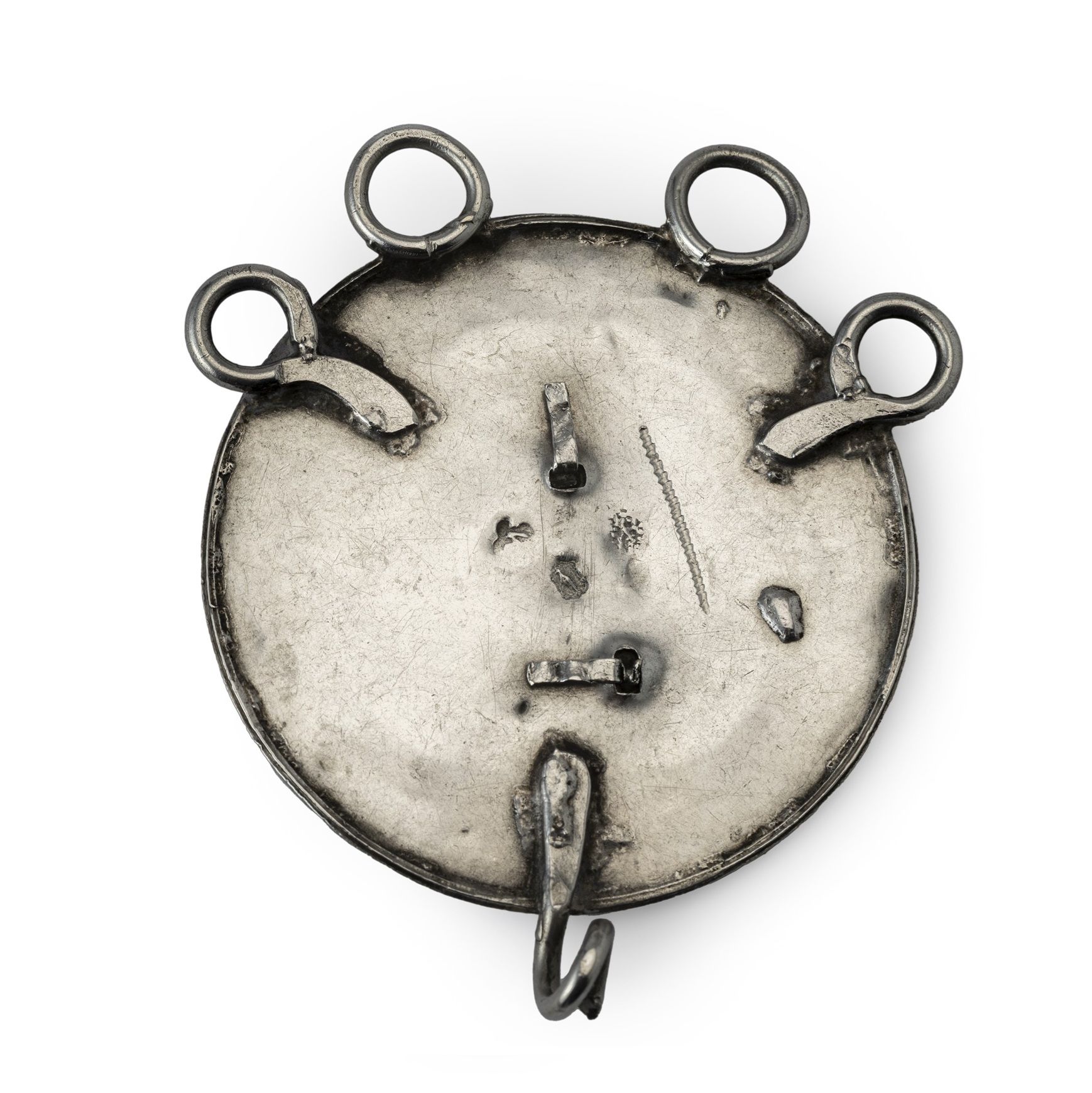
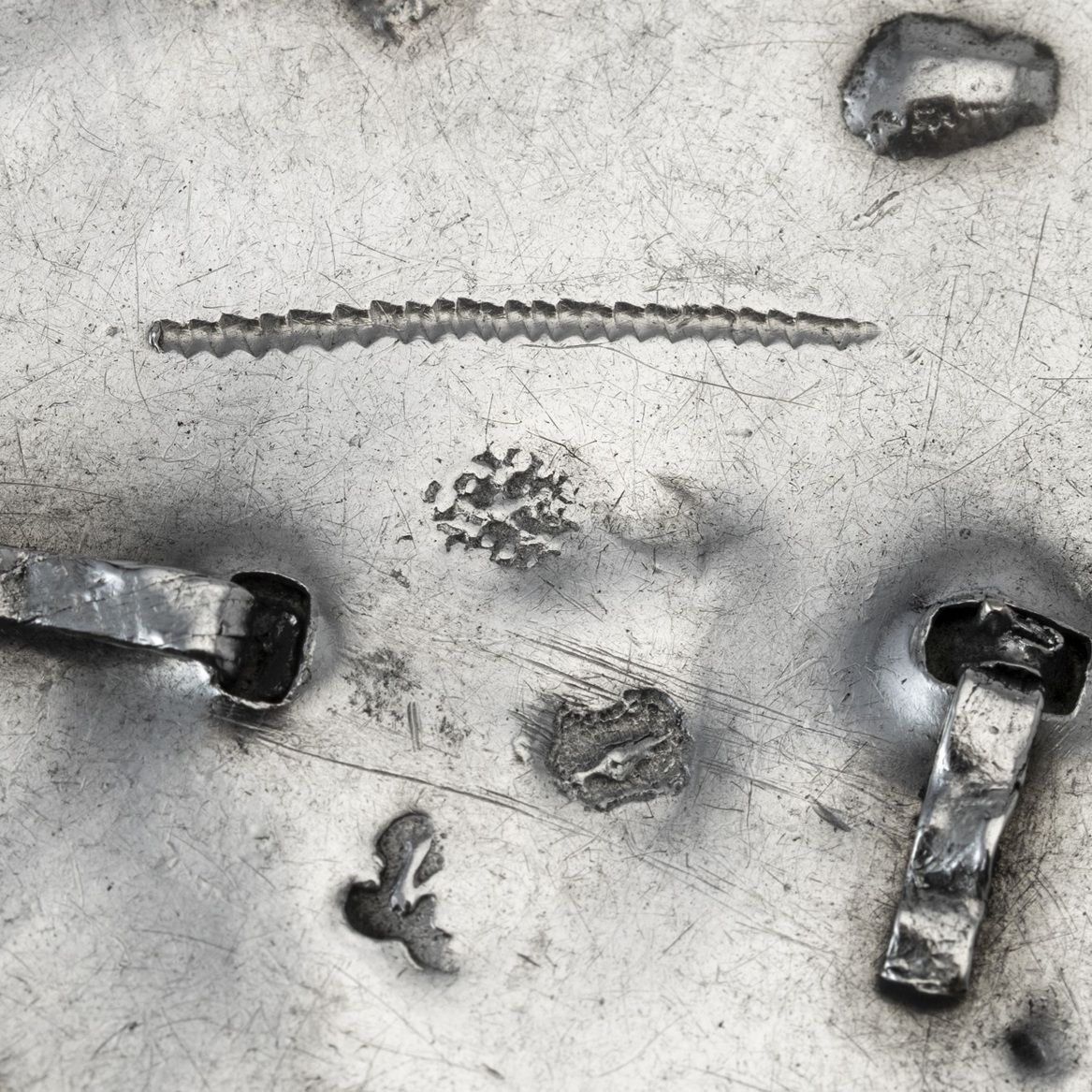
Silver | Parcel-gilt | Fully marked atthe reverse and displaying an assay stripe
H. 9,1 cm. (including rings) D. 7,1 cm. 49 gram
PROVENANCE
Collection Baron van den Bogaerde van Terbrugge | Castle Heeswijk | The Netherlands
Auction | Frederik Muller | Amsterdam | 22 June 1900 | As part of lot 944-Y | With illustration
Private collection | The Netherlands
REFERENCE LITERATURE
Jolles, J.A. (1974). De Schuttersgilden en Schutterijen van Noord-Brabant. Arnhem, Vol I & II
Iven, W. (1983). Schutters Gilden in Noord-Brabant. Helmond
Koldeweij, A.M. red. (1985). Zilver uit ‘s-Hertogenbosch. Nijmegen, p. 41, p. 90
Nissen, P. (2000). Schuttersgilden en hun beschermheiligen. Uden, pp. 54-57
CATALOGUE NOTE
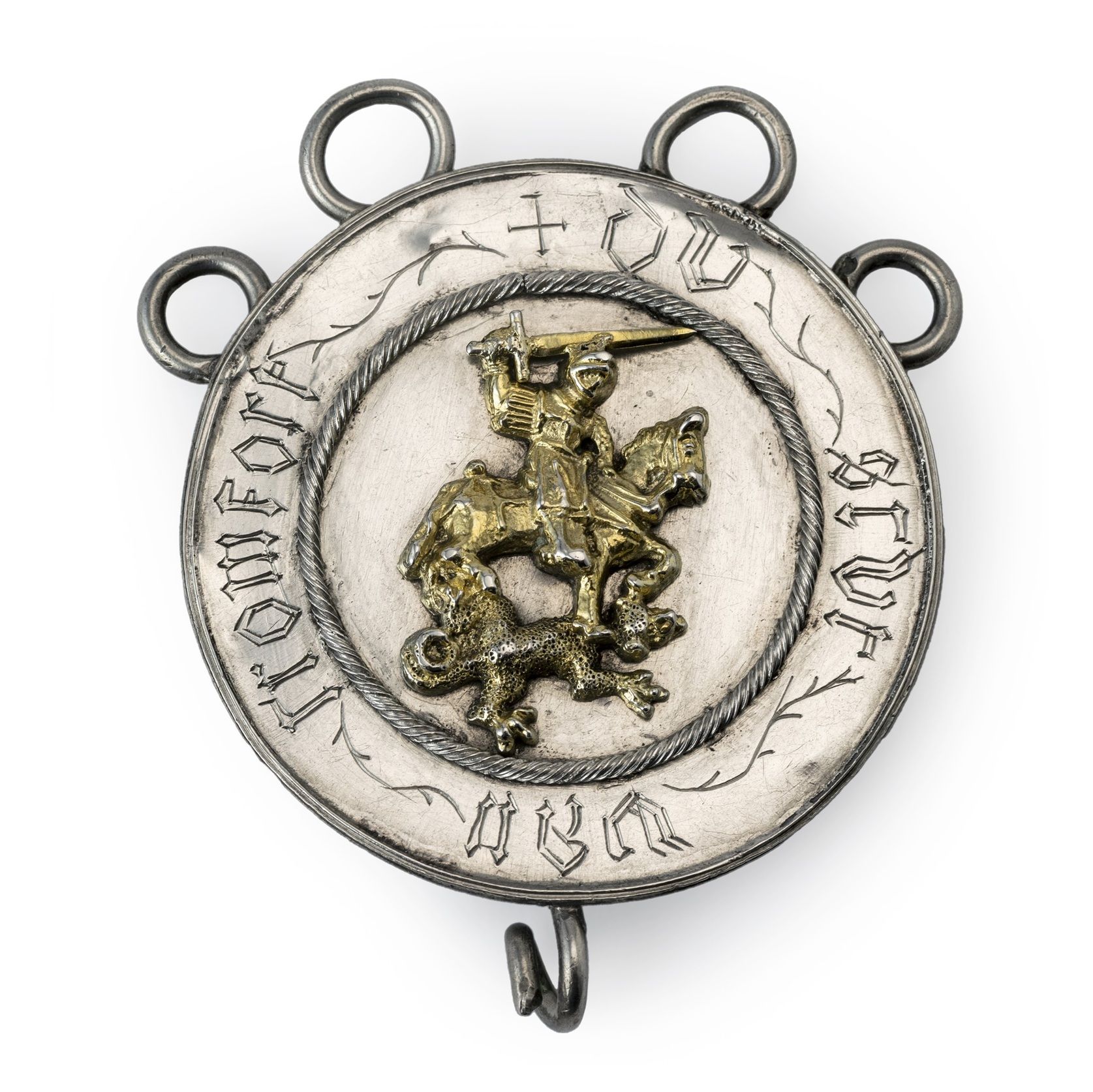
The mid-sixteenth-century circular patron sign of the marksmen’s Guild of Cromvoirt (near Vught in the South of the Netherlands) is engraved on the outer rim with the text ‘+ DV SCVT VAN CROMFORT‘ in Gothic capitals. In the middle, surrounded by a cable rim, the silver-gilt figure of St. George on horseback slaying the dragon, is applied. Twigs are engraved between the words. Four circular suspension eyes are mounted at the top and a suspension hook below.
Fully marked at the reverse and displaying an assay stripe. Here ‘SCVT’ is an abbreviation of the Dutch word ‘schutterij’, or ‘marksmen’s guild’, a local military organisation. Little has been written about the marksmen’s guild of St. Joris (George) of Cromvoirt. It must have been founded around 1516 and existed until the mid-19th century. It was a marksmen’s guild that shot with the longbow. The Noordbrabants Museum in Den Bosch has eight silver guild plates, from 1615-1772, from the St. Joris Guild of Cromvoirt in its collection. A patron-sign is one of the most important pieces of silver in the possession of a guild. It is part of the socalled ‘Kings-chain’ and usually the parrot-shaped Kings-trophy is suspended from it. The sign itself, usually in the shape of a circular medallion – which is also known as the Guild’s Jewel (‘Gildenjuweel’) – depicts the patron- saint of the specific Guild.
The maker’s mark of the silversmith Peter Vallickners appears on the oldest inculpation plate (1538-1642) of Den Bosch as the twentieth sign. He became a master in 1537, but in 1535 he already had an apprentice. From 1537 to 1538 Bauken die Speelman was his apprentice and in 1548 Hanrich Rutten. Peter Vallickners must have died before January 29, 1559. He had his workshop on Markt – Minderbroedersstraat from 1547 to 1552. During his working life he was an assay master for the guild for two years.
PROVENANCE
The Van den Bogaerde family, originally from West Flanders, has lived in Bruges for centuries. In 1705 and 1717 respectively, Andries (II) and his nephew Pieter van den Bogaerde were ennobled. Since the marriage in 1785 of André F.E. van den Bogaerde with M.J. van Larebeke, lady of Terbrugge, ‘van Terbrugge’ was added to the surname. One of the sons of this couple, Andreas J.L. van den Bogaerde van Terbrugge, was governor of North Brabant from 1830 to 1842. Previously, he was successively a member of the Provincial Council and Knighthood of East Flanders (1816), mayor of Waasmunster (1818) and district commissioner of the land of Waas (1820). He then lived in the city of Sint-Niklaas. In 1828 he became district commissioner and militia commissioner in Ghent. He had held these positions for less than two years when he became governor of North Brabant on 4 February 1830. When in November 1830 all civil servants from the southern Netherlands were dismissed in the north as a result of the events in the south, an exception was made for Andreas J.L. van den Bogaerde on the intercession of the Minister of the Interior, Van Doorn. In 1830 he was ennobled in the Netherlands with the title of baron and in 1835 he bought the lordships of Heeswijk and Dinther and shortly afterwards he settled at Heeswijk Castle. He soon showed his cultural interest. In 1830 he became a member of the Society of Dutch Literature, he also participated in the establishment of the Provincial Society of Arts and Sciences of North Brabant and collected many valuable works of art in his castle. In the 19th century, the Van den Bogaerde aristocrats amassed a large collection of art and antiques, which became the largest in the country. This collection was on display, as it was kept at Heeswijk Castle in ‘Museum van den Bogaerde’. In addition, books, maps, prints, pamphlets, manuscripts and archive
documents were purchased. They were also kept in large numbers at Heeswijk and Castle Nemelaer. After the death of his son Donat in 1895, lawsuits immediately arose about the validity of the will. For the most part, however, it has remained in force. It was only stipulated that no prohibition on the sale of the antiquities collection could be derived from the will. This collection was therefore largely auctioned around 1900 – including the Cromvoirt patron sign – at Frederik Muller in Amsterdam.