
Antwerp 1590 – Antwerp 1652
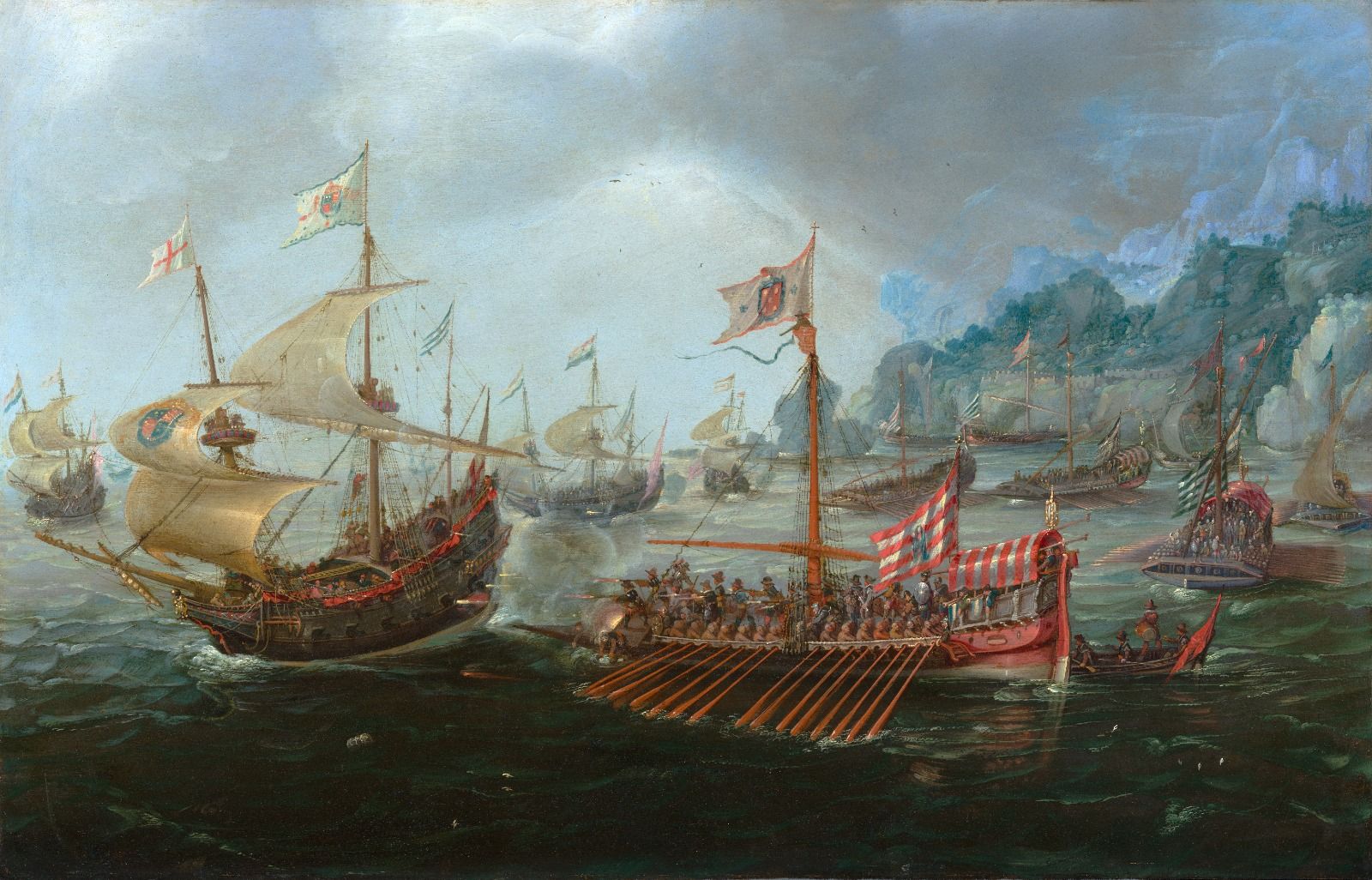
The Battle in the Strait between Calais and Dover on 3-4 October 1602, between the Spanish Galleys of Federico Spinola and Dutch and English Warships
Monogrammed in ligature ‘AVE’ | Left under
Oil on copper
H. 44 cm. W. 68.4 cm.
PROVENANCE
Collection C. Turner | London.
Collection Nell | Bonn
Acquired by the grandfather of the present owner in the 1920s.
LITERATURE
Brozius, J. & Kattenburg, S. (2020). ‘Zeeslag om de Straat van Dover in oktober 1602, Door de ‘schilder van grote galeien en schepen’. In: Vind, September 2020
CATALOGUE NOTE
Seen from a high point of view, a battle scene is set before a fortified coastline. In the foreground a Spanish galleon – with a cross topping its mast and the Madonna and Child emblazoned across its red and white stripped flag – rows towards an English three-master, an English cannon and towards Spanish muskets firing at each other. Other warships, bearing the flag of the United Provinces, can be seen beyond. An old label on the reverse of the copper plate identifies the work as The Battle of Gibraltar by Hendrik Vroom, who designed the ten tapestries depicting the English navy against the Spanish Armada that hung in the House of Lords before they were damaged by fire. Whether the Battle of Gibraltar is actually depicted here, is questionable because of the distinct presence of two St. George’s crosses and what appear to be two English coats-of-arms. The battle of the 25th of April 1607 was fought by the United Provinces and the Spanish, without involvement from the English.
Andries van Eertvelt was born in Antwerp in 1590, where he joined the Guild of St Luke as a master in 1609/10. He is generally seen as the first Flemish marine painter of the seventeenth century. However, his work reflects the enduring influence of Pieter Bruegel the Elder. There is a discernible ‘Dutch’ influence in van Eertvelt’s work, which may have come from Hendrick Vroom, despite van Eertvelt not necessarily having been Vroom’s pupil. Eertvelt lived in Italy, 1628-30, staying with the painter Cornelis de Wael in Genoa. After his residence in Italy, van Eertvelt was painted probably by van Dyck in 1632. His high reputation is reflected in the celebration of his work in Cornelis de Bie’s Het Gulden Cabinet van de Edel Vry Schilderconst (The Golden Cabinet of the Honourable Free Art of Painting). His pupils reputedly included Hendrick van Minderhout, Matthieu van Plattenberg, Sebastian Castro and Kasper van Eyck.
The strong brushwork is exemplary for Eertvelt’s stile furioso, which seems to derive from the work of Agostino Tassi and would be crucial for the development of the Flemish seventeenth-century sea piece.