
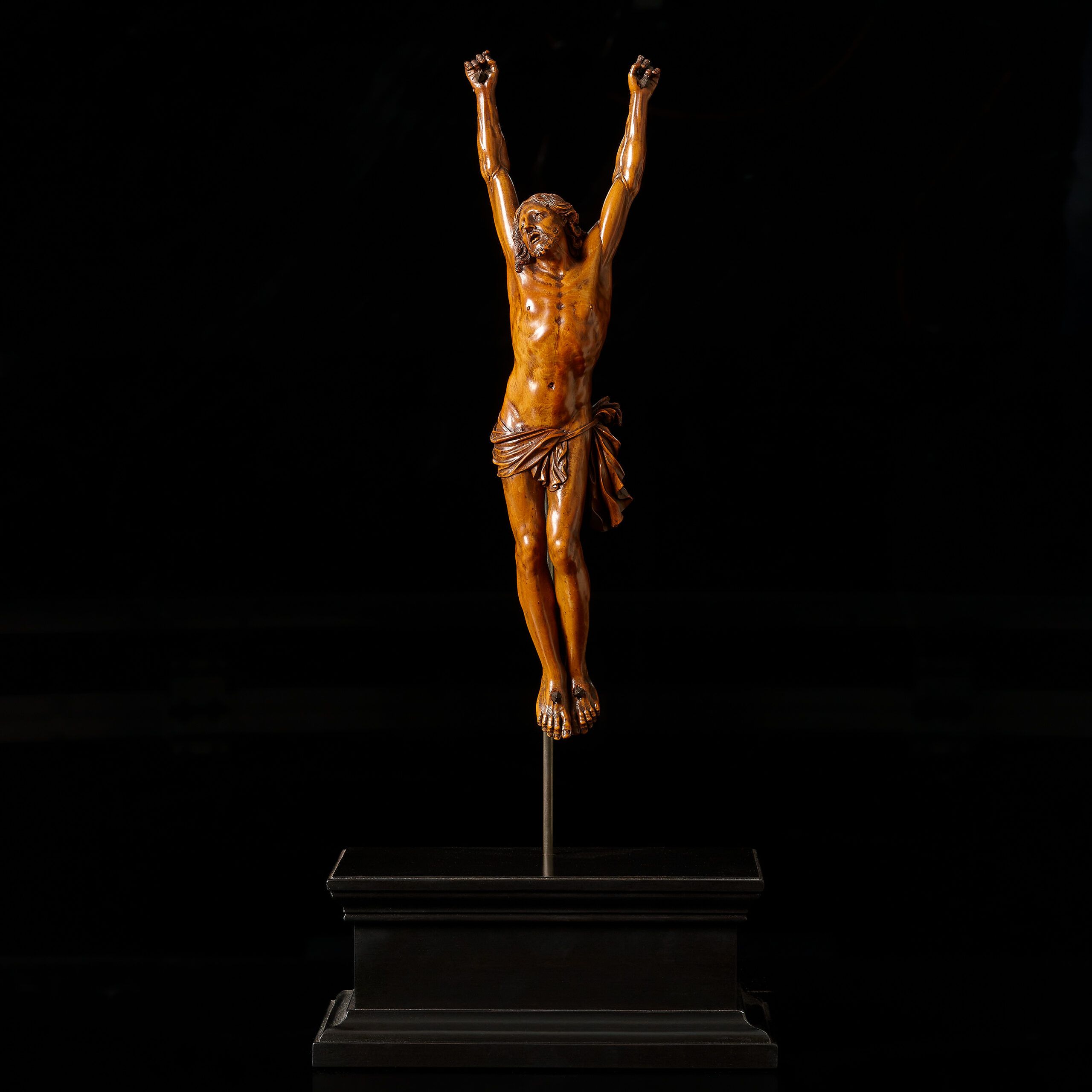
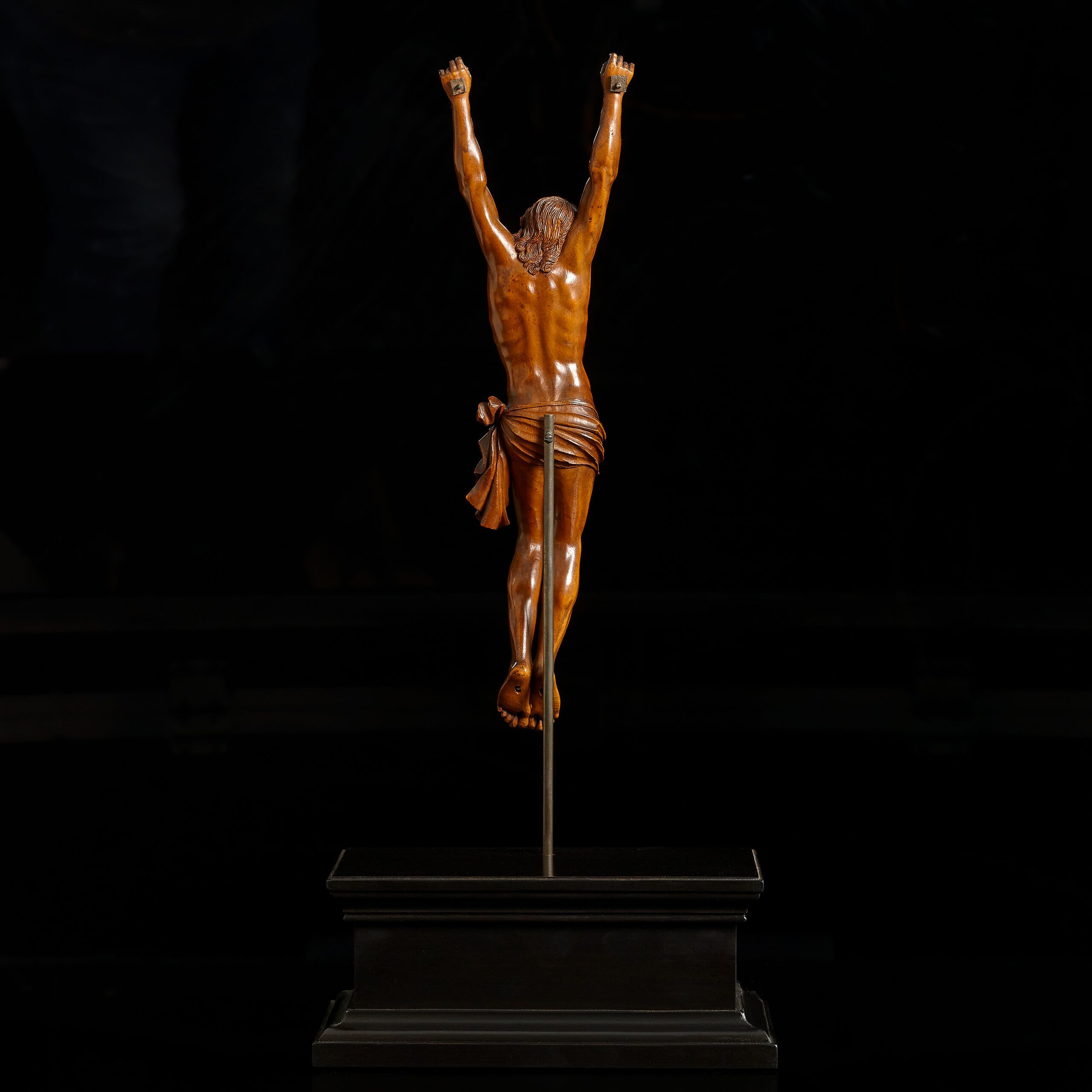
Baroque | Third quarter of the 17th Century | Ca. 1660
A Jansenist Cristo Vivo
Boxwood | Carved in full round | On ebonized base
H. 33 cm. W. 9 cm. (excl. base)
H. 47,2 cm. W. 21,4 cm. (incl. Base)
PROVENANCE
Private collection | The Netherlands
REFERENCE LITERATURE
Nieuwdorp, H. (1977). De beeldhouwkunst in de eeuw van Rubens in de Zuidelijke Nederlanden en het prinsbisdom Luik. Brussels: KMKG, pp. 325-327 nrs. 294-298
CATALOGUE NOTE
We are grateful to Prof. Dr. F.T. Scholten, senior curator sculpture at the Rijksmuseum in Amsterdam, for his kind assistance in cataloguing this statuette and placing it in the circle of François Du Quesnoy (1597–1643)
This fine boxwood sculpture – quite literally – bears the influence of two important Flemish masters: François Du Quesnoy and Peter Paul Rubens. The work can be placed within the circle of the influential Flemish sculptor François Du Quesnoy (1597-1643). Prof. Dr. F.T. Scholten dates the dates the piece in the third quarter of the 17th century, ca, 1660. Du Quesnoy – also known as Francesco Fiammingo in Italy – was a prominent Baroque sculptor from Brussels. He spent a significant part of his career in Rome, where he studied ancient sculptures and created works that contrasted with the emotional style of Bernini. His father, Hiëronymus Duquesnoy the Elder, was a sculptor at the court of Archduke Albert of Austria and Archduchess Isabella of Spain. Du Quesnoy’s early works attracted the attention of the archduke, who provided him with the means to continue his studies in Rome. He remained in Rome for the rest of his life, working on various sculptures, including the famous Manneken Pis fountain in Brussels.
The type of Corpus is know as Cristo Vivo – the living Christ – depicted before his death on the Cross. Furthermore it is known as a Jansenist Corpus. The distinct iconography depicts a type of crucifix in which Christ’s arms are angled upwards is regularly referred to as Jansenist because the range of Christ’s symbolic embrace is shortened. This alteration of Christ’s outstretched arms is said to illustrate to the Jansenists’ notion that Christ only saves an elite group of Christians that is predestined for Heaven. These corpora are likely to follow the model of Pieter Paul Rubens’ influential paintings of the Crucified Christ in the Royal Museum of Fine Arts in Antwerp (1610-1611) and the Alte Pinkothek in Munich (1615), which predates the advent of Jansenism by several decades. A drawing is kept in the collection of the Museum Boijmans Van Beuningen in Rotterdam (Peter Paul Rubens, Christ on the Cross, ca. 1631, coll. Museum Boijmans Van Beuningen, Rotterdam, inv./cat.nr. Rubens 3; RKD nr. 275795; see: Corpus Rubenianum Ludwig Burchard , pt. 6 (2000), p. 129-131, no. 32).