
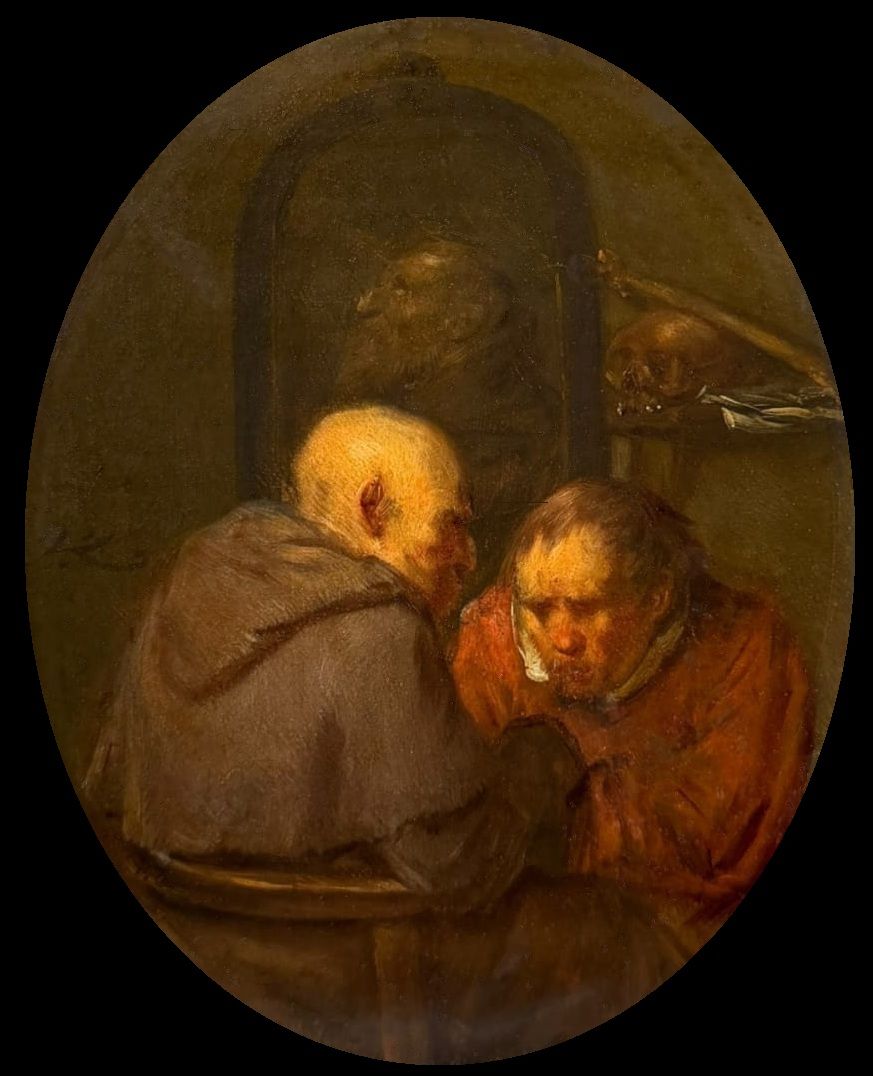
Haarlem 1634 – London ca. 1702/4
The Confession – An Allochory of the Seance of Hearing
Signed with the monogram in ligature ‘HK’ | Middle left
Oil on copper
H. 13,1 cm. W. 10,9 cm.
PROVENANCE
Sale Sotheby’s | Amsterdam | 14 November 1990 | Lot 55
Private collection | The Netherlands
Collection Dr A. Wieg Fine Art Master Drawing and Paintings | Amsterdam | 1996
Where acquired by
Private collection | Papendrecht | The Netherlands | With proof of purchase
EXPERTISE
With certificate authenticity and valuation report by Dr A.J. Wieg, dd. 13 April 1996 and valuation report
by P. Overduin, dd. 2 October 2002
RECORD
The present picture is recorded at the RKD in The Hague under nrs. 468633 and 468634
CATALOGUE NOTE
Small in size yet virtuously executed in quick and loose brushstrokes, this charming miniature on copper may arguably be considered among the highlights within the late oeuvre of the Haarlem genre painter Egbert van Heemskerck the Elder. Van Heemskerck was known and celebrated for his pictures depicting comic low-life genre scenes in the manner of the two foremost genre painters of seventeenth-century Holland, Adriaen van Ostade (1610-1685) and Adriaen Brouwer (1604-1638). The present picture depicts a monk taking the confession form a peasant. Van Heemskerck explored the theme of the confession several times e.g. The Confession, oil on panel, H. 31.cm. W. 24.5 cm., RKD inv.nr. 194303 and A monk hears a Peasant’s Confession, oil on panel, H. 16.5 cm. W. 12.5 cm., RKD inv.nr. 47573. The latter work is accompanied by its pendant Three singing Monks at a Table, RKD inv.nr. 47574.
The confession is one the seven Sacraments of the Roman Catholic Church, exclusively administrated by priests and as such much criticized by the Protestant reformers. Particularly the pictures depicting the Three singing Monks at a Table places these scenes by Van Heemskerck in a satirical or comical narrative – a trade for which he was much celebrated by his contemporaries. Especially when related to e.g. Drinking monk, signed ‘HK’, oil on panel, H. 31 cm. W. 27 cm., RKD inv.nr. Coll. Museum Bredius, The Hague, inv.nr. 169-1946, RKD inv.nr. 25631. Still, the scene of a monk taking the confession may also be interpreted in another way, as the theme also appears in a series of the Five Senses, representing the Sense of Hearing (e.g. Attributed to Egbert van Heemskerck I or Egbert van Heemskerck II, Series of five paintings depicting the senses, oil on copper, H. 15.5 cm. W. 12.5 cm., Sale Veilinghuis Van Spengen). However the scene may be interpreted, the extraordinary quality of the present picture is indicative of the heights that Van Heemskerck’s oeuvre achieved in his maturity.
The Haarlem born master Egbert van Heemskerck was the son of surgeon Jasper Jaspersz. van Heemskerck and Marytge Jansdr. van Stralen. He first became a pupil of the painter Pieter de Grebber. In 1651, after Jasper’s death, Marytge married the art dealer and innkeeper Jan Wijnants, the father of the landscape painter Jan Wijnants, so that Jan and Egbert became stepbrothers. Egbert van Heemkerck became a member of the Guild of Saint Luke of Haarlem in 1646. On 17 January 1654 he married Hester Bastiaens. van den Heuvel (ca. 1637-after 1669). Their son, Egbert van Heemskerck II (1676-1744) would also become a painter. He Egbert van Heemskerck I travelled to Italy between May 1655 and March 1661. In the early 1670s he moved to London. He specialised in a kind of subject matter, such as the present picture, common in The Netherlands but new to English painting, depictions of groups of ordinary people in comic or vulgar situations, including rowdy tavern scenes. He worked at the Royal Court, where in fact one of his often satirical paintings apparently landed him in serious trouble with King Charles II. He may have been patronised by the extravagant courtier, John Wilmot, 2nd Earl of Rochester. According to contemporary critics his work also found a flourishing market among “the waggish collectors and the lower rank of virtuosi”. Though he is registered as having died in London in 1704, he was listed by Laurens van der Vinne as one of the painters who had predeceased his father in 1702.