
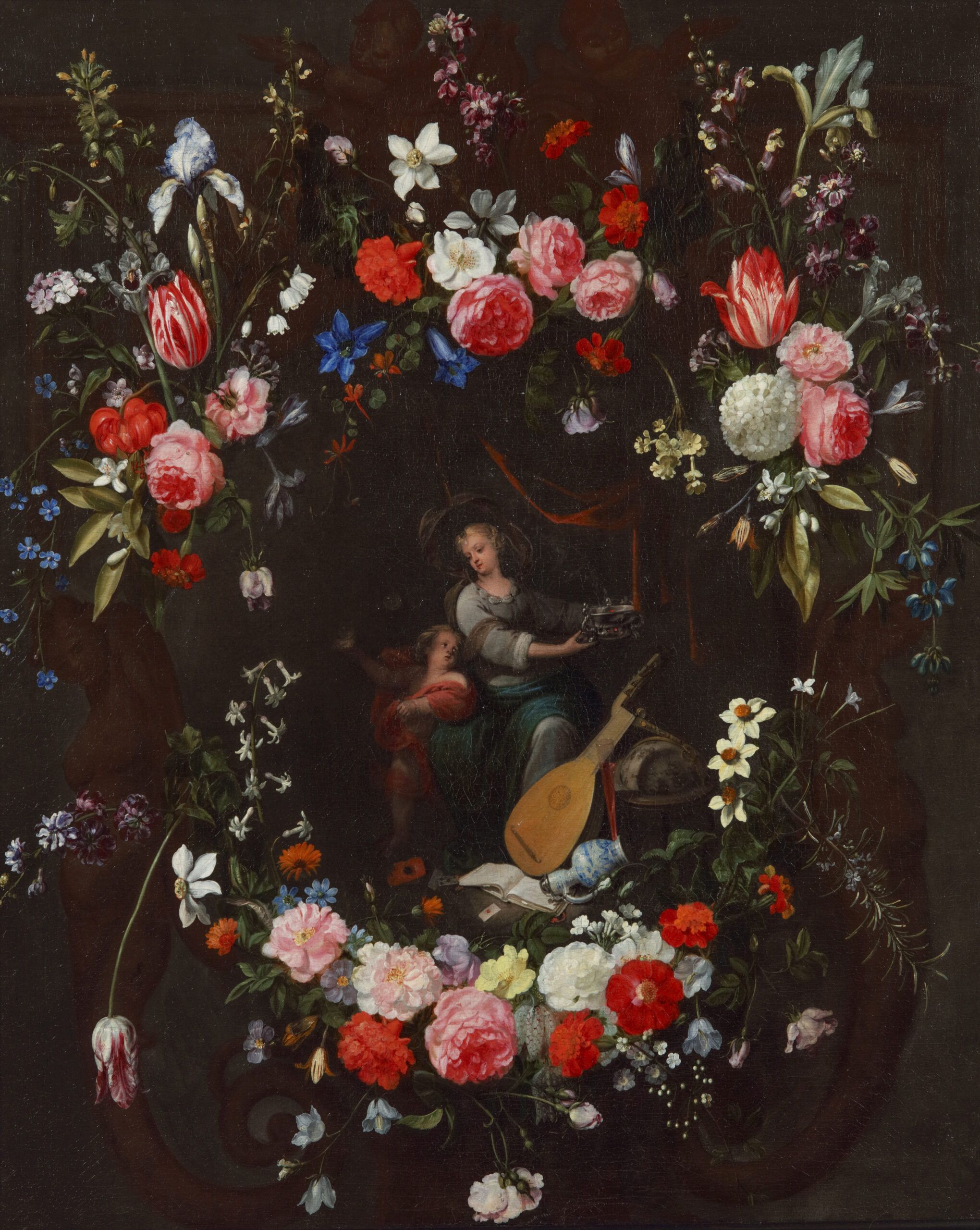
Antwerp 1601- Antwerp ca. 1692
A Garland of Flowers with an Allegory of Human Vanity
Oil on canvas
H. 107 cm. W. 87,8 cm.
PROVENANCE
Private collection | Belgium | As Gerard Seghers
Dutch private collection
CATALOGUE NOTE
Though garlands of flowers are not uncommon in the oeuvre of the Flemish Master Frans Ykens, the present Allegory of Human Vanity as a profane subject is rare. Frans Ykens was the nephew and pupil of the Flemish still-life painter Osias Beert, who was married to a sister of Frans’s father. Around 1629 Ykens made a trip to the Provence visiting Aix and Marseille. After his return in 1631 he was admitted to the Antwerp Guild of Saint Luke. He lived and worked in Antwerp until moving to Brussels in the mid 1660’s where he spent the rest of his long life. In this painting we see flowers arranged around a sculpted cartouche with putti and angels. In the middle we see a woman holding up a simmering fire in a brazier and a boy blowing soap bubbles from a shell. At their feet we see all kinds of man-made artifacts pointing at human earthly activities as, arts, science, literature, music, playing games and drinking. The hand that painted the inner part looks similar to other motives in his garland paintings but we cannot be certain that it was painted by Ykens himself. Frans Ykens devoted his career entirely to still-lives ranging from small delicate ones on copper depicting flowers, glassware and small animals to larger still lives with dead birds and fish and sumptuous kitchen still lives. One of his specialities was the garland of flowers – as the present picture – flowers and fruit often arranged round a religious or mythological motive. The allegory of vanity in the middle of this painting is quite rare for Ykens and in general. Dated works are known from 1635 until 1663 according to Dr. Fred G. Meijer in his indispensable Dictionary of Dutch and Flemish Still life painters working in oils. Frans Ykens is mentioned in old inventories as a painter of religious genre pieces, but these were probably painted by Jan Ykens who was probably, but not certain, a cousin.